POLIO Public Health Emergency of International Concern (PHEIC); WHO/OCHA Emergencies

Emergencies

POLIO
Public Health Emergency of International Concern (PHEIC)

Polio this week as of 24 March 2021
:: On Tuesday 16 March, Egypt and United Arab Emirates were elected to co-chair the new ministerial-level subcommittee on polio eradication in the Eastern Mediterranean Region giving a major push to polio eradication efforts in the region. Read more
:: The Financial Accountability Committee (FAC) meets quarterly to advise the POB on key financial issues, ensure the quality of GPEI’s financial accountability practices, and serve as a forum for donor engagement on financial commitments and accountability requirements. Take a look at the new 2021 FAC terms of reference available here.

Summary of new WPV and cVDPV viruses this week (AFP cases and ES positives):
:: Afghanistan: one WPV1 and four cVDPV2 positive environmental samples
:: Pakistan: three WPV1 and four cVDPV2 positive environmental samples
:: Côte d’Ivoire: two cVDPV2 positive environmental samples
:: Liberia: one cVDPV2 positive environmental sample
:: Niger: one cVDPV2 positive environmental sample
:: South Sudan: three cVDPV2 cases
:: Tajikistan: two cVDPV2 cases and two cVDPV2 positive environmental samples

::::::
::::::

WHO/OCHA Emergencies

Editor’s Note:
Continuing with this edition, we include information about the last apparent update evident on the WHO emergency country webpages, recognizing almost universal and significant interims since last update regardless of the level of the emergency listed.

WHO Grade 3 Emergencies [to 27 Mar 2021]

Democratic Republic of the Congo – No new digest announcements [Last apparent update: 12 Jan 2021]
Mozambique floods – No new digest announcements identified [Last apparent update: 3 November 2020]
Nigeria – No new digest announcements identified [Last apparent update: 29 Jun 2020]
Somalia – No new digest announcements identified [Last apparent update: 17 July 2020]
South Sudan – No new digest announcements identified [Last apparent update: 4 February 2020]
Syrian Arab Republic – No new digest announcements identified [Last apparent update: 24 October 2020]
Yemen – No new digest announcements identified [Last apparent update: 30 June 2020]

::::::

WHO Grade 2 Emergencies [to 27 Mar 2021]
Afghanistan – No new digest announcements identified [Last apparent update: 5 July 2020]
Angola – No new digest announcements identified [Last apparent update: 16 March 2021]
Burundi – No new digest announcements identified [Last apparent update: 04 July 2019]
Burkina Faso – No new digest announcements identified [Last apparent update: 10 mars 2021]
Cameroon – No new digest announcements identified [Last apparent update: 22 August 2019]
Central African Republic – No new digest announcements identified [Last apparent update: 12 June 2018]
Ethiopia – No new digest announcements identified [Last apparent update: 22 August 2019]
Iran floods 2019 – No new digest announcements identified [Last apparent update: 2 March 2020]
Iraq – No new digest announcements identified [Last apparent update: 21 February 2020]
Libya – No new digest announcements identified [Last apparent update: 7 October 2019]
Malawi Floods – No new digest announcements identified [Last apparent update 05 March 2021]
Measles in Europe – No new digest announcements identified [Last apparent update: 16-12-2020]
MERS-CoV – No new digest announcements identified [Last apparent update: 8 July 2019]
Mozambique – No new digest announcements identified [Last apparent update: 03 November 2020]
Myanmar – No new digest announcements identified [Last apparent update: 11 février 2021]
Niger– No new digest announcements identified [Last apparent update:06 mars 2021]occupied Palestinian territory – No new digest announcements identified [Last apparent update: 4 September 2019]
HIV in Pakistan – No new digest announcements identified [Last apparent update: 27 August 2019]
Sao Tome and Principe Necrotizing Cellulitis (2017) – No new digest announcements
Sudan – No new digest announcements identified [Last apparent update: 24 June 2020]
Ukraine – No new digest announcements identified [Last apparent update: 1 May 2019]
Zimbabwe – No new digest announcements identified [Last apparent update: 10 May 2019]

::::::

WHO Grade 1 Emergencies [to 27 Mar 2021]

Chad – No new digest announcements identified [Last apparent update: 30 June 2018]
Djibouti – No new digest announcements identified [Last apparent update: 25 novembre 2020]
Kenya – No new digest announcements identified [Last apparent update: 06 March 2021]
Mali – No new digest announcements identified [Last apparent update: 3 May 2017]
Namibia – viral hepatitis – No new digest announcements identified [Last apparent update: 20 July 2018]
Tanzania – No new digest announcements identified [Last apparent update: 21 October 2020]

::::::
::::::

UN OCHA – L3 Emergencies
The UN and its humanitarian partners are currently responding to three ‘L3’ emergencies. This is the global humanitarian system’s classification for the response to the most severe, large-scale humanitarian crises. 
Syrian Arab Republic – No new digest announcements identified
Yemen – No new digest announcements identified

::::::

UN OCHA – Corporate Emergencies
When the USG/ERC declares a Corporate Emergency Response, all OCHA offices, branches and sections provide their full support to response activities both at HQ and in the field.
COVID-19 – No new digest announcements identified
East Africa Locust Infestation – No new digest announcements identified

::::::
::::::

Not Too Late to Undo Forest Damage, Secretary-General Says, in Message for International Day, while Warning ‘We Risk a Point of No Return’

Heritage Stewardship

Not Too Late to Undo Forest Damage, Secretary-General Says, in Message for International Day, while Warning ‘We Risk a Point of No Return

19 March 2021
SG/SM/20635
Following is UN Secretary-General António Guterres’ message for the International Day of Forests, observed on 21 March:

Humanity’s well-being is inextricably linked to the health of our planet.  Forests play a crucial role.

Forests filter the air we breathe and the water we drink.  They regulate our climate, absorbing one third of the global greenhouse gases emitted each year. Forests provide habitat to 80 per cent of all known terrestrial species, many of which are under threat.  Today, more than 1 million of the planet’s estimated 8 million plant and animal species are at risk of extinction.  Some 1.6 billion people depend directly on forests for food, shelter, energy, medicines and income.

Despite all that they provide, forest loss continues at an alarming rate.  We continue to lose 10 million hectares of forests, an area roughly the size of Iceland, every year.  Deforestation also increases the risks of infectious disease outbreaks and pandemics.

This year marks the beginning of the United Nations Decade on Ecosystem Restoration, which calls for action to prevent, halt and reverse the degradation of forests and other ecosystems.

If we fail to act now, we risk a point of no return.  But it is not too late to undo some of the damage we have caused.  The crises our planet faces require urgent action by all — Governments, international and civil society organizations, the private sector, local authorities and individuals.

Indigenous peoples are leading the way.  They care for the Earth’s biodiversity and achieve conservation results with very few financial resources and little support.

On this International Day of Forests let us plant the seeds for a sustainable future by committing to restore and conserve our forests for the benefit of people and the planet.

.

International Organization for Standardization (ISO)  [to 20 Mar 2021]
https://www  .iso.org/news_archive/x/
News
By Clare Naden on 19 March 2021

International Day of Forests
Healthy forests for a healthy planet.
ISO 38200, Chain of custody of wood and wood-based products, facilitates sustainable forestry through enabling the traceability of wood products. It provides reassurance to customers of wood suppliers that products come from legally harvested sources along the whole supply chain, thus encouraging the use of sustainable wood and deterring illegal methods.

Also contributing to the restoration of forests is ISO 14055-1, Environmental management – Guidelines for establishing good practices for combatting land degradation and desertification – Part 1: Good practices framework, which provides good-practice guidelines for tackling land degradation and desertification in arid and non-arid regions…

UNESCO brings museums of the world together to reflect on their future

Heritage Stewardship

UNESCO brings museums of the world together to reflect on their future
15/03/2021
UNESCO brought together 12 museum directors from around the world at an online debate on 18 March entitled Reflections on the Future of Museums (2 to 5 pm, Central European Time). The discussion focused on the impact of the pandemic on their institutions, how they are addressing ongoing challenges and preparing the future of their museums.

Estimated to number around 95,000 worldwide in 2020, museums have been particularly hard hit by the pandemic. Ninety percent of them closed their doors, while others have been put to different uses. Whereas some museums are currently reopening their doors to visitors, others, according to the International Council of Museums (ICOM), may never open again.

To overcome the challenges of a world deeply marked by the COVID-19 pandemic, it is becoming crucial for museums to adapt and reinvent themselves. Questions regarding their future are becoming more pressing than ever and the debate will provide an opportunity to discuss the conditions and environment needed to operate the transformation of museums at the international level.

List of panelists: 

Barbara Helwing, Director of the Vorderasiatisches Museum (Berlin)

Tristram Hunt, Director of the Victoria & Albert Museum (London)

Deborah Lynn Mack, Director of the National Museum of African Art, Smithsonian (Washington, D.C.)

Xudong Wang, Director of the Palace Museum (Beijing)

Juliana Restrepo, Director of the National Museum of Colombia (Bogota)

Antonio Saborit, Director of the National Museum of Anthropology (Mexico City)

Ahmed Farouk Ghoneim, Executive Director of the National Museum of Egyptian Civilization (Cairo)

Barbara Jatta, Director of the Vatican Museums (Vatican City)

Mikhail Piotrovski, Director of the Hermitage Museum (Saint Petersburg)

Hamady Bocoum, Director of the Museum of Black Civilizations (Dakar).


Webcast: http://webcast.unesco.org/live/room-12/en

UN Network on Migration Launches “Migration Network Hub”, a Knowledge and Solutions Platform on the Global Compact for Safe, Orderly and Regular Migration

Migration

UN Network on Migration Launches “Migration Network Hub”, a Knowledge and Solutions Platform on the Global Compact for Safe, Orderly and Regular Migration
2021-03-18 19:41
Geneva – The United Nations Network on Migration launches today (18/03) the Migration Network Hub. It is the first knowledge platform and connection hub that supports UN Member States in the implementation, follow-up and review of the Global Compact for Safe, Orderly and Regular Migration (GCM).

This tool is intended to share migration knowledge, expertise, good practices and initiatives related to the GCM among Member States, practitioners and the UN system. Through a community of practice, users can participate in online discussions with peers, attend webinars, share resources and publications and showcase flagship initiatives…

The Hub provides high-quality, curated content, analysis and information on all aspects of migration as covered in the GCM. Peer review ensures quality control, so content approved for inclusion is relevant, up-to-date and in line with the GCM and its guiding principles.

The platform is accessible here.

Private Engagement in Education in Emergencies: Rights and Regulations

Education in Emergencies

Private Engagement in Education in Emergencies: Rights and Regulations
Advocacy Brief – INEE
Dr Francine Menashy and Dr Zeena Zakharia.
Published 10 March 2021 :: 25 pages
The Challenge
Efforts to secure inclusive and equitable education for all have prompted calls for greater engagement by the private sector, asserting that businesses and foundations can play significant roles as partners in achieving Sustainable Development Goal 4 (SDG4).

In recent years, given shortfalls in public financing and the need for urgent responses, private actors have increasingly become involved in various aspects of educational programming for education in emergencies (EiE). The arrangement, however, can produce tensions between private engagement and humanitarian response in education, which needs to be addressed and in turn requires extra coordination, advocacy and attention. This brief explores some of these tensions and makes recommendations to support the prioritization of safe, equitable, and quality public education for all children and young people affected by crises.

INEE supports every young person’s right to education and recognizes the State as the primary duty-bearer of schooling, in alignment with international declarations, frameworks, and legal instruments that assert and protect the right to education.

Legal instruments that protect the right to education
These include:
:: Universal Declaration of Human Rights (1948),
:: Fourth Geneva Convention (1949),
:: Convention Relating to the Status of Refugees (1951),
:: UNESCO Convention against Discrimination in Education (1960),
:: International Convention on the Elimination of All Forms of Racial Discrimination (1965),
:: International Covenant on Economic, Social and Cultural Rights (1966),
:: Convention on the Elimination of All Forms of Discrimination against Women (1979),
:: Convention on the Rights of the Child (1989),
:: Jomtien Declaration (1990),
:: World Education Forum Framework for Action (2000),
:: Millennium Development Goals (2000),
:: Convention on the Rights of Persons with Disabilities (2006),
:: UN General Assembly Resolution on the Right to Education in Emergency Situations (2010),
:: 2030 Sustainable Development Goals (2015), and
:: the Abidjan Principles (2019),
in addition to numerous regional human rights treaties and national legal commitments.

Key Recommendations for Private Sector Participation in EiE
:: Prioritize the “do no harm” principle of humanitarianism. All private sector activities in EiE must adhere to the “do no harm” principle and ensure the educational rights of affected populations.

:: Prioritize the participation of affected communities. Without active com¬munity input, business-supported interventions risk decontextualized design and implementation that are misaligned with local interests and knowledge systems, leading to poor educational results and potentially discriminatory practices that produce, sustain, or exacerbate conflict.

:: Support the long-term sustainability of public education. Effective private sector involvement in EiE requires a sustained and ongoing commitment to public education.

:: Regulate private sector activities. Private actors involved in education in emergencies must be regulated by the State and held to the same account¬ability principles as other non-governmental actors and state agencies/entities, in line with legally binding international human rights standards to ensure quality, equity, and access, especially with regard to learners and families affected by crisis.

:: Promote transparency in profit-seeking activities. Transparency regarding conditions of funding and profit-seeking activities, such as creating new mar¬kets for products, brand association and product testing, may help to identify conflicts of interest that counter the “do no harm” principle.

:: Ensure that private funding to EiE is transparent, equitable, and harmo¬nized. Private financing for EiE must not undermine the responsibility of the State to provide free quality education to all children and young people.

:: Develop specific guidance on private participation in EiE. Given the unique issues relating to private sector participation in EiE, an addition to the Abi¬djan Principles (see below) that directly addresses these issues would help clarify expectations for State and private sector responses and intervention in such situations.

OIE-WAHIS: A new era for animal health data

One Health

OIE-WAHIS: A new era for animal health data
At a time when the world is facing an unprecedented pandemic, the importance of animal disease surveillance has become evident. To support countries maintaining global transparency and reporting matters of animal and public health, the World Organisation for Animal Health (OIE) launches the leading most technologically advanced reference platform for animal disease and veterinary capacities reporting – the World Animal Health Information System (OIE-WAHIS).

Paris, 18 March 2021 –  Since its creation in 1924, the OIE is the mandated international organisation collecting data on, observing and analysing animal diseases throughout the world. Through its current World Animal Health Information System (WAHIS), the Organisation ensures the prompt dissemination of information on potentially devastating outbreaks and facilitates decision making in terms of international trade of animals and animal products by collecting, verifying and publishing official animal health information, following a standardised process, thus providing high quality, reliable data…

Website: https://wahis.oie.int/#/home

Assessing Country Readiness for COVID-19 Vaccines – First Insights from the Assessment Rollout

Milestones :: Perspectives :: Research

Assessing Country Readiness for COVID-19 Vaccines – First Insights from the Assessment Rollout
World Bank – Publication :: March 11, 2021 :: 28 pages
PDF: http://documents1.worldbank.org/curated/en/467291615997445437/pdf/Assessing-Country-Readiness-for-COVID-19-Vaccines-First-Insights-from-the-Assessment-Rollout.pdf

Executive Summary
The global COVID-19 vaccination campaign, the largest public health initiative ever undertaken, presents challenges unprecedented in scale, speed and specificities, especially in low and middle-income countries. In November 2020, anticipating the availability of safe and effective vaccines for COVID-19, the World Bank together with WHO, UNICEF, the Global Fund, and Gavi rolled out readiness assessments in more than 100 low and middle-income countries. The key insights from the assessments to date present a high-level snapshot of country readiness to deploy COVID-19 vaccines based on initial findings from ongoing assessments in 128 countries. The World Bank is providing $12 billion for developing countries to purchase and distribute COVID-19 vaccines, tests and treatments and strengthen health and vaccination systems to ensure that vaccines get to those who need them. The assessments provide highly valuable insights into countries’ preparedness and will feed into World Bank projects.

Initial findings from the ongoing assessments show that the world’s poorest countries are at varying degrees of readiness for the massive undertaking of vaccinating their populations against the deadly COVID-19 disease.

The assessments reveal that while 85% of countries have developed national vaccination plans and 68% have vaccine safety systems, only 30% have developed processes to train the large number of vaccinators who will be needed for the campaign and only 27% have created social mobilization and public engagement strategies to encourage people to get vaccinated. Given the worrying vaccine hesitancy levels, strategies to generate confidence, acceptance and demand for the vaccine are urgently needed.

The assessments further show that most countries are focusing on strengthening essential aspects of the vaccine delivery chain – enough to advance vaccination schedules and begin inoculating their populations. The pandemic’s devastating toll on health and economies, fear of highly contagious variants and public pressure to start vaccinations have prompted many countries to prepare aggressive vaccine delivery schedules. Although countries have many gaps in readiness, most have prepared well enough in select essential areas to begin inoculating their populations as soon as vaccines become available. Most countries are approaching the COVID-19 vaccine rollout as an emergency and are emphasizing speed and expediency over deliberative system-strengthening. As a result, they are missing out on the benefits of long-lasting improvements that a systems approach could bring.

The assessments show that COVID-19 vaccination campaigns offer unique opportunities for countries to develop specialized digital systems to track vaccines and vaccinated individuals, and monitor vaccine safety and report adverse reactions. In addition, the large-scale vaccination mobilization provides
opportunities to countries to sustainably strengthen the cold chain and introduce environmentally-friendly options that could be of use well beyond the current crisis.

Finally, it is noteworthy that in most countries the assessments have succeeded in elevating the importance of readiness to the highest levels of decision-making. The assessments have brought together government officers, healthcare professionals, the private sector and communities as well as global partners in the largest vaccination campaign in history, and have generated an unprecedented momentum as countries begin inoculating large swathes of the adult population to overcome the virus that has redefined the world in the last fifteen months.

MAIN REPORT FINDINGS
[1] As countries ramp up efforts to vaccinate their populations against the deadly COVID-19 disease, the world’s poorest countries show varying degrees of readiness for this massive undertaking.

[2] The existence of well-functioning child immunization systems is not a strong predictor of country readiness to deliver COVID-19 vaccines.

[3] Most countries are focusing on strengthening essential aspects of the vaccine delivery chain –enough to advance vaccination schedules and begin inoculating their populations.

[4] Few countries are using the opportunity provided by the deployment of COVID-19 vaccines to strengthen health systems and find long-lasting solutions for similar future challenges

[5] COVID-19 vaccination campaigns offer unique opportunities for countries to digitize their information systems for tracking vaccines and monitoring vaccinations

[6] The COVID-19 vaccine rollout is an opportunity to create environmentally friendly cold chain that could be of use well beyond the current crisis

[7] More countries are using indicative top-down methodologies instead of the new assessment framework and associated tools to cost gaps in readiness.

.

Media Release
Gaps Remain in Countries Readiness to Deploy COVID-19 Vaccines
Assessments by World Bank and partners provide insights into more than 120 countries’ readiness to safely distribute vaccines
WASHINGTON, March 18, 2021 – As countries undertake the largest vaccination campaign in history, the World Bank has worked with governments, WHO, UNICEF, the Global Fund and GAVI on assessing countries’ readiness to safely deploy COVID-19 vaccines in 128 low- and middle-income countries. The results indicate that income level and other economic indicators correlate weakly with vaccine preparedness. The report focuses on ten key indicators, including cold chain & logistics, population prioritization, budgeting, training of healthcare personnel, and safety surveillance, among others.

Initial findings show that 85% of countries that participated in the assessments have developed national vaccination plans and 68% have safety measures in place, including systems for reporting adverse reactions. However, only 30% have developed plans to train the large number of vaccinators who will be needed and only 27% have created social mobilization and public engagement strategies to encourage people to get vaccinated. Given worrying  vaccine hesitancy, strategies to generate confidence, acceptance and demand for vaccines are urgently needed. Countries affected by conflict and fragility (37 out of 128) scored lower than other countries on almost all indicators.

“Many developing countries are in the midst of preparing aggressive COVID19 vaccine delivery plans,” said Mamta Murthi, Vice President for Human Development at the World Bank. “While most countries are well enough prepared to begin inoculating their populations, there are still important gaps that must urgently be addressed for wide, large scale vaccination rollouts to succeed.”

The World Bank is providing $12 billion for developing countries to purchase and distribute COVID-19 vaccines, tests, and treatments and strengthen health and vaccination systems to ensure that vaccines get to those who need them. Our vaccination programs will reach over 40 countries in the near-term, amounting to $3 billion out of the $12 billion available. The readiness assessments will inform our projects and help governments and healthcare professionals better understand and manage the complex task of vaccinating large adult populations in a very short timeframe…

Coronavirus [COVID-19] – WHO Public Health Emergency of International Concern (PHEIC)

Milestones :: Perspectives :: Research

Coronavirus [COVID-19] – WHO
Public Health Emergency of International Concern (PHEIC)
https://www.who.int/emergencies/diseases/novel-coronavirus-2019

Weekly Epidemiological and Operational updates
Last update: 23 January 2021
Confirmed cases :: 121 969 223 [week ago: 118 754 336] [two weeks ago: 115 653 459]
Confirmed deaths :: 2 694 094 [week ago: 2 634 370] [two weeks ago: 2 571 823]
Countries, areas or territories with cases :: 223

This image has an empty alt attribute; its file name is screen-shot-2021-03-21-at-9.55.39-pm.png

6 March 2021
Weekly epidemiological update on COVID-19 –  16 March 2021
Overview
In the past week, new cases continued to rise globally, increasing by 10% in the past week to over 3 million new reported cases. After peaking in early January 2021 when there were just under 5 million cases, new cases then declined to around 2.5 million in the week commencing 15 February 2021 but in the past three weeks have increased again. This week, the Americas and Europe continue to account for over 80% of new cases and new deaths, with rises in new cases seen in all regions apart from Africa, where a decrease by 4% has been reported.
In this edition, special focus updates are provided on:
:: Building and maintaining trust – what countries should do to prepare communities for a COVID-19 vaccine, treatment, or a new test; and
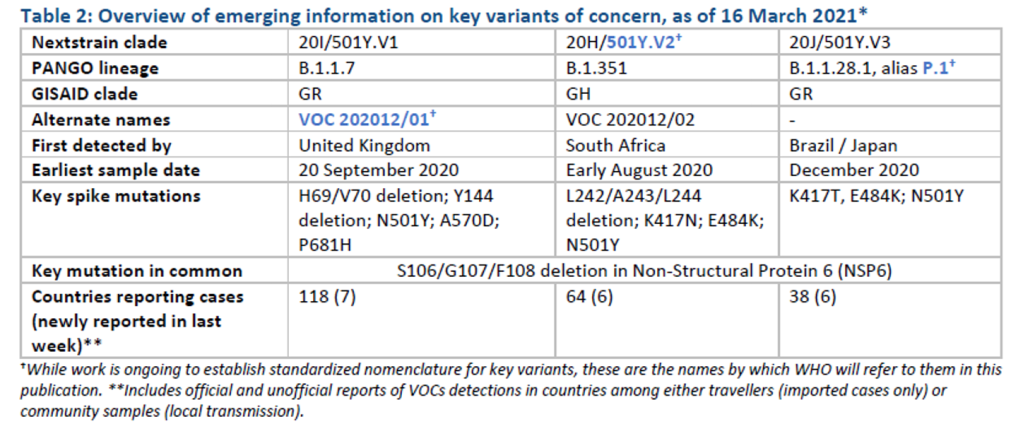
:: SARS-CoV-2 variants of concern:

16 March 202
Weekly operational update on COVID-19 – 16 March 2021
Overview
In this edition of the Weekly Operational Update on COVID-19, highlights of country-level actions and WHO support to Member States include:
:: Historic roll-out of shipments from COVAX facility gathers pace globally
:: International Women’s Day 2021: Challenging barriers women face accessing life-saving knowledge for COVID-19 response
:: Vaccination data now available on the WHO COVID-19 dashboard
:: Preparedness activities including enriched Intra-Action Reviews, WHO facilitated learning on safe hospitals and reviewing preparedness assessment tools for enhancements
:: The Strategic Preparedness and Response Plan (SPRP) 2021 Operational Planning Guidelines, resource requirements and progress made to continue investing in the COVID-19 response and for building the architecture to prepare for, prevent and mitigate future health emergencies
:: Updates on WHO/PAHO procured items, participation in the Unity Studies, and select indicators from the COVID-19 Monitoring and Evaluation Framework

Science Editorial – COVID-19 vaccination passports

Science
19 March 2021 Vol 371, Issue 6535
http://www.sciencemag.org/current.dtl
Editorial
COVID-19 vaccination passports
By Christopher Dye, Melinda C. Mills
As countries grow eager to reignite their economies and people increasingly yearn for mobility and normalcy in life, pressure is mounting for some form of COVID-19 health status certificate that would support these desires. There has already been an explosion of COVID-19 passport initiatives for domestic use and international travel. But scientific, legal, and ethical concerns abound with such documentation. Given the high stakes, what is the path forward?

From doctors’ examinations to ship inspections, clean bills of health have secured passage through centuries of human plagues. Today’s best-known health passport is the International Certificate of Vaccination or Prophylaxis, created by the World Health Organization (WHO). WHO’s Yellow Card has certified vaccinations for cholera, plague, and typhoid, among other infections. There is certainly precedent for a COVID-19 vaccination passport certifying that the holder can travel, study, play, and work without compromising personal or public health. Among newly proposed COVID-19 passport schemes are the WHO’s Smart Vaccination Certificate, Israel’s “green passport,” the European Union’s proposed Digital Green Pass, and the Africa Centres for Disease Control and Prevention’s “My COVID Pass.”

Given the momentum, what are the main principles that COVID-19 passports should follow to ensure their appropriate use?

A COVID-19 passport should be scientifically valid. Passport holders must be protected from illness so that they can carry out the activities for which the passport has been issued and to avoid burdening health services. A passport would ideally certify that holders are not, and cannot become, a source of infection for others. Vaccines have high efficacy in preventing symptomatic COVID-19, and there is growing evidence that they can prevent transmission too. No vaccine is perfect, and it remains to be determined whether vaccines meet minimum requirements for preventing infection and illness. The duration of protection conferred by vaccines should be tied to passport expiry dates, perhaps with options to revoke passports if new coronavirus variants compromise efficacy. These passports should also be judged for their comparative advantage. They may be preferable to viral RNA and antigen tests, which aim to certify that individuals are temporarily free of infection, and to antibody tests, which do not guarantee immunity to infection or disease.

The vaccination certificate should be portable, affordable, and linked safely and securely to the identity of the holder. Ideally, it will be internationally standardized with verifiable credentials and based on interoperable technologies. Forgery and personal data security are dominant concerns, but such problems are routinely solved for financial and other sensitive transactions.

Many issues surround the fair use of vaccination passports. The widely held view is that documents must avoid discrimination and inequity. Ideally, a passport would be exclusive only with respect to its primary purpose, which is to protect the health of individuals and others with whom they come into contact. But such exclusions inevitably raise barriers elsewhere. Some, such as restrictions on nonessential leisure activities, should be relatively easy to manage. The greatest risk is that people for whom vaccination is unacceptable, untested, inaccessible, or impossible are denied access to essential goods and services. This could happen where there is vaccine hesitancy or refusal among certain ethnic minorities; where there are no data on vaccine efficacy for people at risk, such as children and pregnant women; where migrants are undocumented and unreachable; where passports are exclusively digital, barring people without smartphones; and where people are not yet eligible for vaccination. These examples signal the need for alternatives and exemptions.

Some decisions about how to use passports will be made by public debate and consent, drawing on social and ethical norms. Others will be determined by domestic and international law. Some employers have already announced “no jab, no job” policies. In such cases, the freedom of choice for individual employees, set against a firm’s duty and preference for the care of all staff, might be tested in court.

COVID-19 is a new human disease. The challenges presented by vaccination passports are also new in detail, but mostly familiar in kind. Adding to current, imperfect certification procedures by diagnostic tests, vaccination passports are likely to be widely adopted during the pandemic and its probable sequel, endemic and episodic disease. The choice about how passports are used should be guided by exemplary science, appropriate technologies, and fair use for all.

POLIO Public Health Emergency of International Concern (PHEIC); WHO/OCHA Emergencies

Emergencies

POLIO
Public Health Emergency of International Concern (PHEIC)

Polio this week as of 17 March 2021
Summary of new WPV and cVDPV viruses this week (AFP cases and ES positives):
:: Afghanistan: one cVDPV2 case and one cVDPV2 positive environmental sample
:: Pakistan: three WPV1 and eight cVDPV2 positive environmental samples
:: Egypt: three cVDPV2 positive environmental samples
:: Nigeria: three cVDPV2 cases
:: South Sudan: four cVDPV2 cases
:: Senegal: one cVDPV2 positive environmental sample
:: Sierra Leone: three cVDPV2 positive environmental samples

::::::
::::::

WHO/OCHA Emergencies

Editor’s Note:
Continuing with this edition, we include information about the last apparent update evident on the WHO emergency country webpages, recognizing almost universal and significant interims since last update regardless of the level of the emergency listed.

WHO Grade 3 Emergencies [to 20 Mar 2021]

Democratic Republic of the Congo – No new digest announcements [Last apparent update: 12 Jan 2021]
Mozambique floods – No new digest announcements identified [Last apparent update: 3 November 2020]
Nigeria – No new digest announcements identified [Last apparent update: 29 Jun 2020]
Somalia – No new digest announcements identified [Last apparent update: 17 July 2020]
South Sudan – No new digest announcements identified [Last apparent update: 4 February 2020]
Syrian Arab Republic – No new digest announcements identified [Last apparent update: 24 October 2020]
Yemen – No new digest announcements identified [Last apparent update: 30 June 2020]

::::::

WHO Grade 2 Emergencies [to 20 Mar 2021]
Angola
:: The Government of Japan contributes US$ 1 million to UN agencies to support vulnerab…
16 March 2021

Afghanistan – No new digest announcements identified [Last apparent update: 5 July 2020]
Burundi – No new digest announcements identified [Last apparent update: 04 July 2019]
Burkina Faso – No new digest announcements identified [Last apparent update: 10 mars 2021]
Cameroon – No new digest announcements identified [Last apparent update: 22 August 2019]
Central African Republic – No new digest announcements identified [Last apparent update: 12 June 2018]
Ethiopia – No new digest announcements identified [Last apparent update: 22 August 2019]
Iran floods 2019 – No new digest announcements identified [Last apparent update: 2 March 2020]
Iraq – No new digest announcements identified [Last apparent update: 21 February 2020]
Libya – No new digest announcements identified [Last apparent update: 7 October 2019]
Malawi Floods – No new digest announcements identified [Last apparent update 05 March 2021]
Measles in Europe – No new digest announcements identified [Last apparent update: 16-12-2020]
MERS-CoV – No new digest announcements identified [Last apparent update: 8 July 2019]
Mozambique – No new digest announcements identified [Last apparent update: 03 November 2020]
Myanmar – No new digest announcements identified [Last apparent update: 11 février 2021]
Niger– No new digest announcements identified [Last apparent update:06 mars 2021]occupied Palestinian territory – No new digest announcements identified [Last apparent update: 4 September 2019]
HIV in Pakistan – No new digest announcements identified [Last apparent update: 27 August 2019]
Sao Tome and Principe Necrotizing Cellulitis (2017) – No new digest announcements
Sudan – No new digest announcements identified [Last apparent update: 24 June 2020]
Ukraine – No new digest announcements identified [Last apparent update: 1 May 2019]
Zimbabwe – No new digest announcements identified [Last apparent update: 10 May 2019]

::::::

WHO Grade 1 Emergencies [to 20 Mar 2021]

Chad – No new digest announcements identified [Last apparent update: 30 June 2018]
Djibouti – No new digest announcements identified [Last apparent update: 25 novembre 2020]
Kenya – No new digest announcements identified [Last apparent update: 06 March 2021]
Mali – No new digest announcements identified [Last apparent update: 3 May 2017]
Namibia – viral hepatitis – No new digest announcements identified [Last apparent update: 20 July 2018]
Tanzania – No new digest announcements identified [Last apparent update: 21 October 2020]

::::::
::::::

UN OCHA – L3 Emergencies
The UN and its humanitarian partners are currently responding to three ‘L3’ emergencies. This is the global humanitarian system’s classification for the response to the most severe, large-scale humanitarian crises. 
Syrian Arab Republic – No new digest announcements identified
Yemen – No new digest announcements identified

::::::

UN OCHA – Corporate Emergencies
When the USG/ERC declares a Corporate Emergency Response, all OCHA offices, branches and sections provide their full support to response activities both at HQ and in the field.
East Africa Locust Infestation
:: Desert Locust situation update 16 March 2021

COVID-19
:: Coronavirus Disease (COVID-19): Weekly Epidemiological Update (16 March 2021)

::::::
::::::

The Sentinel

Human Rights Action :: Humanitarian Response :: Health :: Education :: Heritage Stewardship ::
Sustainable Development
__________________________________________________
Week ending 13 March 2021 :: Number 358

This weekly digest is intended to aggregate and distill key content from a broad spectrum of practice domains and organization types including key agencies/IGOs, NGOs, governments, academic and research institutions, consortia and collaborations, foundations, and commercial organizations. We also monitor a spectrum of peer-reviewed journals and general media channels. The Sentinel’s geographic scope is global/regional but selected country-level content is included. We recognize that this spectrum/scope yields an indicative and not an exhaustive product. Comments and suggestions should be directed to:

David R. Curry
Editor
GE2P2 Global Foundation – Governance, Evidence, Ethics, Policy, Practice
david.r.curry@ge2p2center.net

PDFThe Sentinel_ period ending 13 Mar 2021

Contents
:: Week in Review  [See selected posts just below]
:: Key Agency/IGO/Governments Watch – Selected Updates from 30+ entities   [see PDF]
:: INGO/Consortia/Joint Initiatives Watch – Media Releases, Major Initiatives, Research:: Foundation/Major Donor Watch -Selected Updates
:: Journal Watch – Key articles

Myanmar junta crackdown likely crimes against humanity requiring coordinated international response – UN expert 

Myanmar

Myanmar junta crackdown likely crimes against humanity requiring coordinated international response – UN expert  [Special Rapporteur on the situation of human rights in Myanmar]
GENEVA (11 March 2021) – The Myanmar junta’s brutal response to peaceful protests likely meets the legal threshold for crimes against humanity, a UN expert told the Human Rights Council today, calling for a united global response in the country’s hour of need.

“The people of Myanmar need not only words of support but supportive action,” said Tom Andrews, the UN Special Rapporteur on the situation of human rights in Myanmar. “They need the help of the international community, now.”

Andrews stressed that a growing body of reporting indicates that the junta’s security forces are committing acts of murder, imprisonment, persecution and other crimes as part of a coordinated campaign, directed against a civilian population, in a widespread and systematic manner, with the knowledge of the junta’s leadership – thereby likely meeting the legal threshold for crimes against humanity.

With the UN Security Council seemingly unwilling to invoke its Chapter VII authority, Andrews said Member States must rally together to take action.

“Today I am therefore urging that as many Member States as possible commit to taking strong, decisive and coordinated action as a coalition of nations – an Emergency Coalition for the People of Myanmar,” he said.

In a statement to the Council, Andrews outlined five options that such a coalition could take immediately: 

[1] stop the flow of funds to the junta, including by imposing targeted sanctions on the junta’s business enterprises and on Myanmar Oil and Gas Enterprise, the single largest source of revenue to the State of Myanmar;

[2] impose an international arms embargo;

[3] ensure accountability for the crimes, through national courts using universal jurisdiction if the Security Council is unwilling to refer the matter to the International Criminal Court;

[4] work directly with local civil society and aid organizations to provide humanitarian assistance whenever possible; and

[5] deny recognition of the military junta as the legitimate government representing the people of Myanmar.

“I sincerely hope that the international community will rise to the occasion of this moment of history by following the lead and the inspiration of the people of Myanmar by coming to their aid as a coordinated whole, in this their moment of need.”

In a report to the Human Rights Council, Andrews details how the Myanmar military illegally overthrew the civilian government last month and proceeded to attack the people of Myanmar by committing the crimes of murder, assault and arbitrary detention. He also details human rights violations preceding the coup in an annex to the report.

UN adopts landmark framework to integrate natural capital in economic reporting

Stewardship – Environmental Economic Accounting

UN adopts landmark framework to integrate natural capital in economic reporting
10 Mar 2021 | DESA

The new framework — the System of Environmental-Economic Accounting—Ecosystem Accounting (SEEA EA) — was adopted by the UN Statistical Commission and marks a major step forward that goes beyond the commonly used statistic of gross domestic product (GDP) that has dominated economic reporting since the end of World War II. This measure would ensure that natural capital—forests, wetlands and other ecosystems—are recognized in economic reporting…

UN Secretary-General António Guterres welcomed the adoption of the new economic and environmental framework. “This is a historic step forward towards transforming how we view and value nature.  We will no longer be heedlessly allowing environmental destruction and degradation to be considered economic progress.”

The new framework can also underpin decision-making at two crucial conferences later this year—COP15 on Biodiversity in Kunming and the Glasgow Climate Conference, COP 26.

According to a new UNEP report, “Making Peace with Nature,” the global economy has grown nearly fivefold over the last 50 years, largely due to a tripling in extraction of natural resources and energy that has fuelled growth in production and consumption. Over the same time, the world population has increased by a factor of two, to 7.8 billion people, and though on average prosperity has also doubled, about 1.3 billion people still live in poverty and some 700 million are hungry…

“As governments to the Convention on Biological Diversity get ready to agree and implement a framework that will recraft our relationship with nature, this new framework will provide an impetus for an accurate accounting of the value of biodiversity” says Elizabeth Maruma Mrema, Executive Secretary of the Convention on Biological Diversity.  “In so doing, it is a step towards sustainable development.”

The new framework recognizes that ecosystems deliver important services that generate benefits for people. In essence, they are assets to be maintained, similar to economic assets. For example, forests play a role in providing communities with clean water, serving as natural water filters with trees, plants and other characteristics, such as soil depth, that help absorb nutrient pollution like nitrogen and phosphorous before it can flow into streams, rivers and lakes…

::::::

System of Environmental Economic Accounting
Information on the new framework can be found at https://seea.un.org/ecosystem-accounting

The SEEA Ecosystem Accounting (SEEA EA) constitutes an integrated and comprehensive statistical framework for organizing data about habitats and landscapes, measuring the ecosystem services, tracking changes in ecosystem assets, and linking this information to economic and other human activity.

The United Nations Statistical Commission adopted the SEEA Ecosystem Accounting at its 52nd session in March 2021. The report of the Commission (subject to editing) can be found here.

This adoption follows a comprehensive and inclusive process of detailed testing, consultation and revision. Today, ecosystem accounts have already been used to inform policy development in more than 34 countries.

Ecosystem accounting – how it works
The SEEA EA is built on five core accounts. These accounts are compiled using spatially explicit data and information about the functions of ecosystem assets and the ecosystem services they produce.

The five ecosystem accounts are:

  • ECOSYSTEM EXTENT accounts record the total area of each ecosystem, classified by type within a specified area (ecosystem accounting area). Ecosystem extent accounts are measured over time in ecosystem accounting areas (e.g., nation, province, river basin, protected area, etc.) by ecosystem type, thus illustrating the changes in extent from one ecosystem type to another over the accounting period.
  • ECOSYSTEM CONDITION accounts record the condition of ecosystem assets in terms of selected characteristics at specific points in time. Over time, they record the changes to their condition and provide valuable information on the health of ecosystems.
  • & 4. ECOSYSTEM SERVICES flow accounts (physical and monetary) record the supply of ecosystem services by ecosystem assets and the use of those services by economic units, including households.
  • MONETARY ECOSYSTEM ASSET accounts record information on stocks and changes in stocks (additions and reductions) of ecosystem assets. This includes accounting for ecosystem degradation and enhancement.

The SEEA EA also supports ‘thematic accounting’, which organizes data around specific policy-relevant environmental themes, such as biodiversity, climate change, oceans and urban areas. Other important thematic accounts would include accounting for protected areas, wetlands and forests.

A key aspect of ecosystem accounting is that it allows the contributions of ecosystems to society to be expressed in monetary terms so those contributions to society’s well-being can be more easily compared to other goods and services we are more familiar with. Monetary estimates can provide information for decision-makers, for example for economic policy planning, cost-benefit analysis, and for raising awareness of the relative importance of nature to society. Ecosystem service values are derived by using a range of economic valuation techniques

COVID-19 Vaccines Must Be Global Public Good, Secretary-General Say

COVID Vaccines – Global Public Good

COVID-19 Vaccines Must Be Global Public Good, Secretary-General Says, Announcing ‘Only Together’ Campaign to Encourage Sharing of Technology, Doses
11 March 2021   SG/SM/20620

One full year into the COVID-19 pandemic, our world has faced a tsunami of suffering. So many lives have been lost. Economies have been upended and societies left reeling. The most vulnerable have suffered the most. Those left behind are being left even further behind.

It has been a year of empty office buildings, quiet streets and closed schools in much of the world. I commend women, men and young people everywhere for adapting to work, learn and live in new ways. I honour health workers for their dedication and sacrifice and all other essential workers who have kept societies running. I salute all those who have stood up to the deniers and disinformation, and have followed science and safety protocols. You have helped save lives.

The United Nations will continue mobilizing the international community to make vaccines affordable and available for all, to recover better, and to put a special focus on the needs of those who have borne the burden of this crisis on so many levels — women, minorities, older persons, persons with disabilities, refugees, migrants and indigenous peoples.

With the vaccine roll-out, there’s some light at the end of the tunnel. COVAX —the global vaccine equity mechanism —  has started delivery around the world, including to some of the lowest-income countries.

Yet I am deeply concerned that many low-income countries have not yet received a single dose, while wealthier countries are on track to vaccinating their entire population. We see many examples of vaccine nationalism and vaccine hoarding in wealthier countries — as well as continued side deals with manufacturers that undermine access for all.

The global vaccination campaign represents the greatest moral test of our times.

It is also essential to restart the global economy — and help the world move from locking down societies to locking down the virus.

COVID-19 vaccines must be seen as a global public good. The world needs to unite to produce and distribute sufficient vaccines for all, which means at least doubling manufacturing capacity around the world.

That effort must start now. Only together can we end this pandemic and recover. Only together can we revive our economies. And then, together, we can all get back to the things we love.

Migrants: Guidance on equitable access to COVID-19 vaccine

COVID Vaccines Access – Migrants

Migrants: Guidance on equitable access to COVID-19 vaccine

GENEVA (8 March 2021) – All migrants should be included in COVID-19 vaccination programmes regardless of their nationality and migration status, experts from the UN, African, European and Inter-American human rights systems urge in a Guidance Note published today. The experts stress that vaccine registration should not be used to collect information about an individual’s migration status and shared with immigration enforcement authorities.

The Guidance Note, jointly issued by the UN Committee on Migrant Workers (CMW), the Special Rapporteur on the human rights of migrants, the Office of the High Commissioner for Human Rights and regional human rights experts, offers six key proposals regarding vaccine distribution. It calls on States to take into account the vulnerabilities, risks and needs of those migrants who are most exposed and vulnerable to coronavirus when drawing up their prioritization lists for vaccination.

“In the context of the COVID-19 pandemic, the rights to health and non-discrimination are fundamental and indispensable. To overcome the pandemic and leave no one behind, these rights must be guaranteed to all migrants regardless of nationality and migration status. All migrants must have access to the vaccine on an equal basis with nationals,” the experts said.

“A number of reports indicate that migrants may be more vulnerable to poor health because of their often low socio-economic status, the process of migration and their vulnerability as non-nationals,” they added.

Regarding the organisation of vaccination campaigns, the experts called for there to be clear firewalls between immigration enforcement and the provision of COVID-19 vaccines. They cautioned that public information campaigns should make it clear that migrants in irregular situations will not be penalized or targeted for immigration enforcement when seeking access to COVID-19 vaccination. “Nobody should be afraid to seek the care they need,” the experts underscored.

They urged States to develop coordinated strategies and mechanisms of cooperation and assistance to guarantee universal and equitable access to COVID-19 vaccines, and to take into special consideration countries that face economic obstacles in securing vaccines for their populations, including migrants and their families.

END

The experts: The UN Committee on the Protection of the Rights of All Migrant Workers and Members of their Families (CMW) is the body of 14 independent experts that monitors implementation of the International Convention on the Protection of the Rights of All Migrant Workers and Members of Their Families by its State parties. It held its first session in March 2004;

Mr. Felipe González Morales (Chile) was appointed Special Rapporteur on the human rights of migrants in June 2017 by the UN Human Rights Council, for an initial period of three years. As a Special Rapporteur, he is independent from any government or organization and serves in his individual capacity. He is Professor of International Law at the Diego Portales University, in Santiago, Chile, where he is also the Director of a Master’s programme in International Human Rights Law;

Ms. Sahli Fadel Maya, Special Rapporteur on Refugees, Asylum Seekers, Internally Displaced Persons and Migrants of the African Commission on Human and Peoples’ Rights.

Mr. Drahoslav Stefanek, Ambassador, Special Representative of the Secretary General on Migration and Refugees of the Council of Europe;

Ms. Julissa Mantilla Falcón, Rapporteur on the Rights of Migrants of the Inter-American Commission on Human Rights.


Joint Guidance Note on Equitable Access to COVID-19 Vaccines for All Migrants
March 2021 :: 3 pages
[Excerpt]
…In light of all of the above, the UN Committee on the Protection of the Rights of All Migrant Workers and Members of their Families, the UN Special Rapporteur on the human rights of migrants, the Office of the United Nations High Commissioner for Human Rights, the Special Rapporteur on Refugees, Asylum Seekers, Internally Displaced Persons and Migrant in Africa of the African Commission on Human and Peoples’ Rights, the Special Representative of the Secretary General on Migration and Refugees of the Council of Europe and the Rapporteur on the Rights of Migrants of the Inter-American Commission on Human Rights urge States to:

[1]  Provide equitable access to COVID-19 vaccination for all migrants and their families on a non-discriminatory basis, regardless of their nationality and migration status.

[2]  Ensure that vaccine prioritization within countries takes into account the vulnerabilities, risks and needs of those migrants who are most exposed and vulnerable to the SARS-COV-2.

[3]  Adopt measures to overcome barriers, establish protocols that facilitate equitable access to vaccination for migrants, including those in irregular situations, and provide targeted outreach and provision of information among migrants in a language they understand and in formats they can access.

[4]  Enact firewalls between immigration enforcement and the provision of COVID-19 vaccination, in order to prevent fear or risk of reporting, detention, deportation and other penalties as result of migration status. Vaccine registration should not be used to collect nor share information about migration status. Communication messages and public information campaigns should make clear that migrants in irregular situations will not be penalized or targeted for immigration enforcement when seeking access to COVID-19 vaccination.

[5]  Avoid rhetoric and terminology that stigmatize and reinforce harmful narratives against migrants that may result in the exclusion of migrants and those in irregular situations from the public health response. Ensure public information and rhetoric regarding public health is inclusive of migrants.

[6] Develop coordinated strategies and mechanisms of cooperation and assistance to guarantee universal and equitable access to vaccines for COVID-19 globally, and to take into special consideration those countries which due to economic or financial factors are facing obstacles to get vaccines for their populations, including migrants and their families.

Rwanda vaccinates refugees and asylum-seekers against COVID-19

Integrity :: Equity

Rwanda vaccinates refugees and asylum-seekers against COVID-19
12 Mar 2021

As the COVID-19 pandemic continues to threaten the lives and rights of refugees, UNHCR, the UN Refugee Agency, welcomes the Rwandan government’s vaccination this week of 416 refugees – one of the first countries in Africa to do so.

Nearly one year since the country’s first registered COVID-19 case and as part of Rwanda’s national vaccination drive, the Rwandan Ministry of Health inoculated 224 refugees residing in the Emergency Transit Mechanism (ETM) centre in Gashora and 192 refugees in six refugee settlements working on the front lines of the pandemic as community health workers and cleaners or security guards at health clinics in the refugee settlements.

Some 230,000 people in Rwanda have been vaccinated against COVID-19, one week after a countrywide campaign began.

“We commend Rwanda’s inclusion of refugees in its response to the pandemic,” said Clementine Nkweta-Salami, UNHCR’s Regional Bureau Director Bureau for the East, Horn of Africa and the Great Lakes. “We appeal to all countries to include refugees in their vaccination programs on par with nationals to ensure that everyone is safe.”…

New UNFPA data reveals that nearly 12 million women lost access to contraception due to disruptions caused by the pandemic, leading to 1.4 million unintended pregnancies

COVID IMPACTS: Access to Contraception

New UNFPA data reveals that nearly 12 million women lost access to contraception due to disruptions caused by the pandemic, leading to 1.4 million unintended pregnancies

New York, 11 March 2021 – UNFPA, the UN sexual and reproductive health agency, released new data today indicating that nearly 12 million women in 115 countries lost access to family planning services, leading to 1.4 million unintended pregnancies resulting from the disruptions caused by COVID-19 over the past year.

“Pregnancies don’t stop for pandemics, or any crisis. We must ensure that women and girls have uninterrupted access to life-saving contraceptives and maternal health medicines,” says UNFPA Executive Director, Dr. Natalia Kanem. “The devastating impact that COVID-19 has had on the lives of millions of women and girls in the past year underscores just how vital it is to ensure the continuity of reproductive health services.”

The COVID-19 pandemic has been the fastest-moving global public health crisis in a century, causing a strain never before seen on global health systems, many of which were forced to divert resources away from their reproductive health services. Women also lost access to health services due to mobility restrictions or fear of traveling to health facilities. The data, by UNFPA and Avenir health, estimates the net impact of these service delivery disruptions.

In the 115 low-and-middle-income countries studied, women faced an average disruption in their family planning services of 3.6 months over the past year, suggesting that many health systems were resilient enough to eventually adapt and continue to provide services. The worst disruptions were largely concentrated in April and May…

Quad Leaders’ Joint Statement: “The Spirit of the Quad”

Milestones :: Perspectives :: Research Quad Leaders’ Joint Statement: “The Spirit of the Quad” March 12, 2021 Statements and Releases [Editor’s text bolding] 1. We have convened to reaffirm our commitment to quadrilateral cooperation between Australia, India, Japan, and the United States. We bring diverse perspectives and are united in a shared vision for the free and open Indo-Pacific. We strive for a region that is free, open, inclusive, healthy, anchored by democratic values, and unconstrained by coercion. We recall that our joint efforts toward this positive vision arose out of an international tragedy, the tsunami of 2004. Today, the global devastation wrought by COVID-19, the threat of climate change, and security challenges facing the region summon us with renewed purpose. On this historic occasion of March 12, 2021, the first-ever leader-level summit of the Quad, we pledge to strengthen our cooperation on the defining challenges of our time. 2. Together, we commit to promoting a free, open rules-based order, rooted in international law to advance security and prosperity and counter threats to both in the Indo-Pacific and beyond. We support the rule of law, freedom of navigation and overflight, peaceful resolution of disputes, democratic values, and territorial integrity. We commit to work together and with a range of partners. We reaffirm our strong support for ASEAN’s unity and centrality as well as the ASEAN Outlook on the Indo-Pacific. Full of potential, the Quad looks forward to the future; it seeks to uphold peace and prosperity and strengthen democratic resilience, based on universal values. 3. Our common goals require us to reckon with the most urgent of global challenges. Today, we pledge to respond to the economic and health impacts of COVID-19, combat climate change, and address shared challenges, including in cyber space, critical technologies, counterterrorism, quality infrastructure investment, and humanitarian-assistance and disaster-relief as well as maritime domains. 4. Building on the progress our countries have achieved on health security, we will join forces to expand safe, affordable, and effective vaccine production and equitable access, to speed economic recovery and benefit global health. With steadfast commitment to the health and safety of our own people, we also recognize that none of us can be safe as long as the pandemic continues to spread. We will, therefore, collaborate to strengthen equitable vaccine access for the Indo-Pacific, with close coordination with multilateral organizations including the World Health Organization and COVAX. We call for transparent and results-oriented reform at the World Health Organization. We are united in recognizing that climate change is a global priority and will work to strengthen the climate actions of all nations, including to keep a Paris-aligned temperature limit within reach. We look forward to a successful COP 26 in Glasgow. We will begin cooperation on the critical technologies of the future to ensure that innovation is consistent with a free, open, inclusive, and resilient Indo-Pacific. We will continue to prioritize the role of international law in the maritime domain, particularly as reflected in the United Nations Convention on the Law of the Sea (UNCLOS), and facilitate collaboration, including in maritime security, to meet challenges to the rules-based maritime order in the East and South China Seas. We reaffirm our commitment to the complete denuclearization of North Korea in accordance with United Nations Security Council resolutions, and also confirm the necessity of immediate resolution of the issue of Japanese abductees. As long-standing supporters of Myanmar and its people, we emphasize the urgent need to restore democracy and the priority of strengthening democratic resilience. 5. To advance these goals and others, we will redouble our commitment to Quad engagement. We will combine our nations’ medical, scientific, financing, manufacturing and delivery, and development capabilities and establish a vaccine expert working group to implement our path-breaking commitment to safe and effective vaccine distribution; we will launch a critical- and emerging-technology working group to facilitate cooperation on international standards and innovative technologies of the future; and we will establish a climate working group to strengthen climate actions globally on mitigation, adaptation, resilience, technology, capacity-building, and climate finance. Our experts and senior officials will continue to meet regularly; our Foreign Ministers will converse often and meet at least once a year. At the leader level, we will hold an in-person summit by the end of 2021. The ambition of these engagements is fit to the moment; we are committed to leveraging our partnership to help the world’s most dynamic region respond to historic crisis, so that it may be the free, open, accessible, diverse, and thriving Indo-Pacific we all seek.  

Coronavirus [COVID-19] – Public Health Emergency of International Concern (PHEIC)

Milestones :: Perspectives :: Research

Coronavirus [COVID-19] – WHO
Public Health Emergency of International Concern (PHEIC)
https://www.who.int/emergencies/diseases/novel-coronavirus-2019

Weekly Epidemiological and Operational updates
Last update: 23 January 2021
Confirmed cases :: 118 754 336 [week ago: 115 653 459] [two weeks ago: 113 076 707]
Confirmed deaths :: 2 634 370 [week ago: 2 571 823] [two weeks ago: 2 512 272]
Countries, areas or territories with cases :: 223

9 March 2021
Weekly epidemiological update – 9 March 2021

8 March 2021
Weekly operational update on COVID-19 – 8 March 2021

POLIO Public Health Emergency of International Concern (PHEIC); WHO/OCHA Emergencies

Emergencies

POLIO
Public Health Emergency of International Concern (PHEIC)

Polio this week as of 10 March 2021
:: In this special op-ed, Spanish Foreign Minister and Gender Champion for Polio Eradication Ms Arancha González Laya, reflects on the role of women in polio eradication following her recent visit to Chad.

Summary of new WPV and cVDPV viruses this week (AFP cases and ES positives):
:: Afghanistan: 14 cVDPV2 cases and 10 cVDPV2 positive environmental samples
:: Pakistan: six WPV1 positive environmental samples
:: Côte d’Ivoire: three cVDPV2 positive environmental samples
:: Dr Congo: three cVDPV2 cases
:: Mali: five cVDPV2 cases
:: Niger: four cVDPV2 positive environmental samples
:: Sierra Leone: Five cVDPV2 cases
:: Sudan: one cVDPV2 case
:: Tajikistan: two cVDPV2 cases

::::::
::::::

WHO/OCHA Emergencies

Editor’s Note:
Continuing with this edition, we include information about the last apparent update evident on the WHO emergency country webpages, recognizing almost universal and significant interims since last update regardless of the level of the emergency listed.

WHO Grade 3 Emergencies [to 13 Mar 2021]

Democratic Republic of the Congo – No new digest announcements [Last apparent update: 12 Jan 2021]
Mozambique floods – No new digest announcements identified [Last apparent update: 3 November 2020]
Nigeria – No new digest announcements identified [Last apparent update: 29 Jun 2020]
Somalia – No new digest announcements identified [Last apparent update: 17 July 2020]
South Sudan – No new digest announcements identified [Last apparent update: 4 February 2020]
Syrian Arab Republic – No new digest announcements identified [Last apparent update: 24 October 2020]
Yemen – No new digest announcements identified [Last apparent update: 30 June 2020]

::::::

WHO Grade 2 Emergencies [to 13 Mar 2021]
Burkina Faso
:: Revue sectorielle de l’année 2020 du secteur de planification santé 10 mars 2021

Afghanistan – No new digest announcements identified [Last apparent update: 5 July 2020]
Angola – No new digest announcements identified [Last apparent update: 02 March 2021]Burundi
Cameroon – No new digest announcements identified [Last apparent update: 22 August 2019]
Central African Republic – No new digest announcements identified [Last apparent update: 12 June 2018]
Ethiopia – No new digest announcements identified [Last apparent update: 22 August 2019]
Iran floods 2019 – No new digest announcements identified [Last apparent update: 2 March 2020]
Iraq – No new digest announcements identified [Last apparent update: 21 February 2020]
Libya – No new digest announcements identified [Last apparent update: 7 October 2019]
Malawi Floods – No new digest announcements identified [Last apparent update 05 March 2021]
Measles in Europe – No new digest announcements identified [Last apparent update: 16-12-2020]
MERS-CoV – No new digest announcements identified [Last apparent update: 8 July 2019]
Mozambique – No new digest announcements identified [Last apparent update: 03 November 2020]
Myanmar – No new digest announcements identified [Last apparent update: 11 février 2021]
Niger– No new digest announcements identified [Last apparent update:06 mars 2021]occupied Palestinian territory – No new digest announcements identified [Last apparent update: 4 September 2019]
HIV in Pakistan – No new digest announcements identified [Last apparent update: 27 August 2019]
Sao Tome and Principe Necrotizing Cellulitis (2017) – No new digest announcements
Sudan – No new digest announcements identified [Last apparent update: 24 June 2020]
Ukraine – No new digest announcements identified [Last apparent update: 1 May 2019]
Zimbabwe – No new digest announcements identified [Last apparent update: 10 May 2019]

::::::

WHO Grade 1 Emergencies [to 13 Mar 2021]

Kenya
:: Kenya receives COVID-19 vaccines and launches landmark national campaign 06 March 2021

Chad – No new digest announcements identified [Last apparent update: 30 June 2018]
Djibouti – No new digest announcements identified [Last apparent update: 25 novembre 2020]
Mali – No new digest announcements identified [Last apparent update: 3 May 2017]
Namibia – viral hepatitis – No new digest announcements identified [Last apparent update: 20 July 2018]
Tanzania – No new digest announcements identified [Last apparent update: 21 October 2020]

::::::
::::::

UN OCHA – L3 Emergencies
The UN and its humanitarian partners are currently responding to three ‘L3’ emergencies. This is the global humanitarian system’s classification for the response to the most severe, large-scale humanitarian crises. 
Yemen
:: 12 March 2021 Yemen: Ma’rib Situation Update No. 2, 12 March 2021

Syrian Arab Republic – No new digest announcements identified

::::::

UN OCHA – Corporate Emergencies
When the USG/ERC declares a Corporate Emergency Response, all OCHA offices, branches and sections provide their full support to response activities both at HQ and in the field.
East Africa Locust Infestation – No new digest announcements identified
COVID-19 – No new digest announcements identified

::::::
::::::